Case Study2024–Present • iOS, Web
Vora IQ
Founder and Lead Product Designer
The Brief
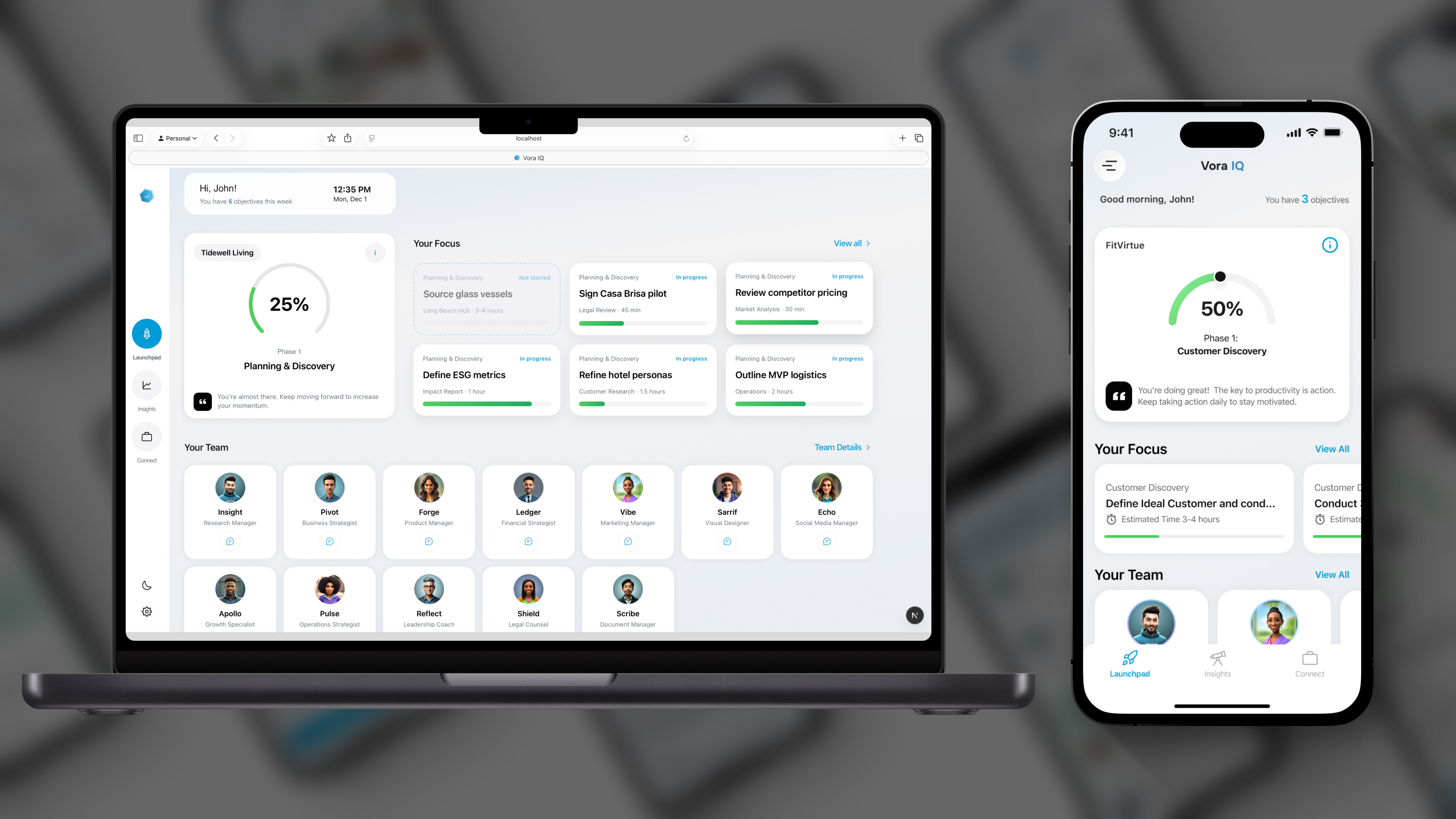
AI Operating System for Founders. Designing clarity, momentum, and execution for people starting from zero.
Context
Early-stage founders face a paradox. Tools are abundant, but clarity is rare. Idea validation, planning, research, execution, and growth are spread across disconnected apps, documents, and advice. Most aspiring founders do not fail because they lack ideas. They fail because they lack structure, momentum, and a clear path forward. Vora IQ was created to solve this exact problem. The opportunity was to design an intelligent, all-in-one platform that helps founders move from idea to execution without juggling tools, frameworks, or advisors. Unlike traditional SaaS products, Vora IQ needed to feel less like software and more like a capable partner that thinks, plans, and executes alongside the user. The challenge was ambitious. Build clarity where there is confusion. Build momentum where there is overwhelm. And do it in a way that feels intuitive, trustworthy, and fast.
Core Challenges
Key obstacles that required strategic design thinking to overcome.
01
Ambiguity by Default — Users often arrive with vague ideas, half-formed goals, or no clear starting point
02
Tool Fragmentation — Founders are forced to manage validation, planning, tasks, research, and marketing across multiple products
03
Execution Drop-Off — Most tools stop at insight. Very few drive consistent follow-through
04
AI Trust Gap — Users are skeptical of AI advice unless it is structured, explainable, and actionable
05
Designing for Many Roles — The platform needed to serve aspiring founders, solo operators, and small business owners without becoming bloated
Goal
Design an AI-powered platform that turns unstructured ideas into clear plans, actionable tasks, and ongoing execution. Success meant users could quickly understand where they are, what to do next, and why it matters, without managing multiple tools or workflows.
Role
Founder and Lead Product Designer responsible for product vision, UX strategy, interaction design, system architecture, AI agent design, and end-to-end experience. This included defining core concepts such as viability scoring, AI teammates, phased execution, and business memory.
Users
Primary users include aspiring founders, solo entrepreneurs, consultants, and small business owners. They are motivated but time-constrained, often overwhelmed by choices, and highly sensitive to friction. They value clarity, speed, and practical guidance over theory or motivation alone.
Key Insight
Founders do not need more ideas. They need a system that turns intent into action. Clarity creates confidence. Confidence creates momentum.
Solution Overview
Vora IQ was designed as an AI operating system for founders. At its core is a conversational AI co-pilot that helps users articulate their idea, evaluates its viability, and generates a structured execution plan. Instead of isolated features, the platform is built around a continuous flow: Idea clarification leads to a viability score. The viability score leads to a roadmap. The roadmap leads to tasks. Tasks are supported by AI teammates that execute alongside the user. Everything is connected. Nothing feels fragmented.
Design Principles
Clarity beats cleverness. Execution beats insight. AI should explain its thinking. Progress must always be visible. Reduce cognitive load at every step.
Research and Insights
Research was driven through a combination of founder interviews, competitive analysis, and direct observation of how early-stage entrepreneurs actually work. Key insights emerged quickly: • Founders were overwhelmed by choice but under-supported in execution. • Most planning tools created documents, not momentum. • AI tools felt impressive but ungrounded without structure. • Users wanted to feel guided, not managed. These insights shaped a product that emphasizes sequencing, context, and progressive disclosure rather than dumping information all at once.
Core Experience Decisions
Key architectural decisions:
Conversational Entry Point
Users begin by talking, not configuring. The AI co-pilot extracts intent and context without forms or templates.
Viability Score
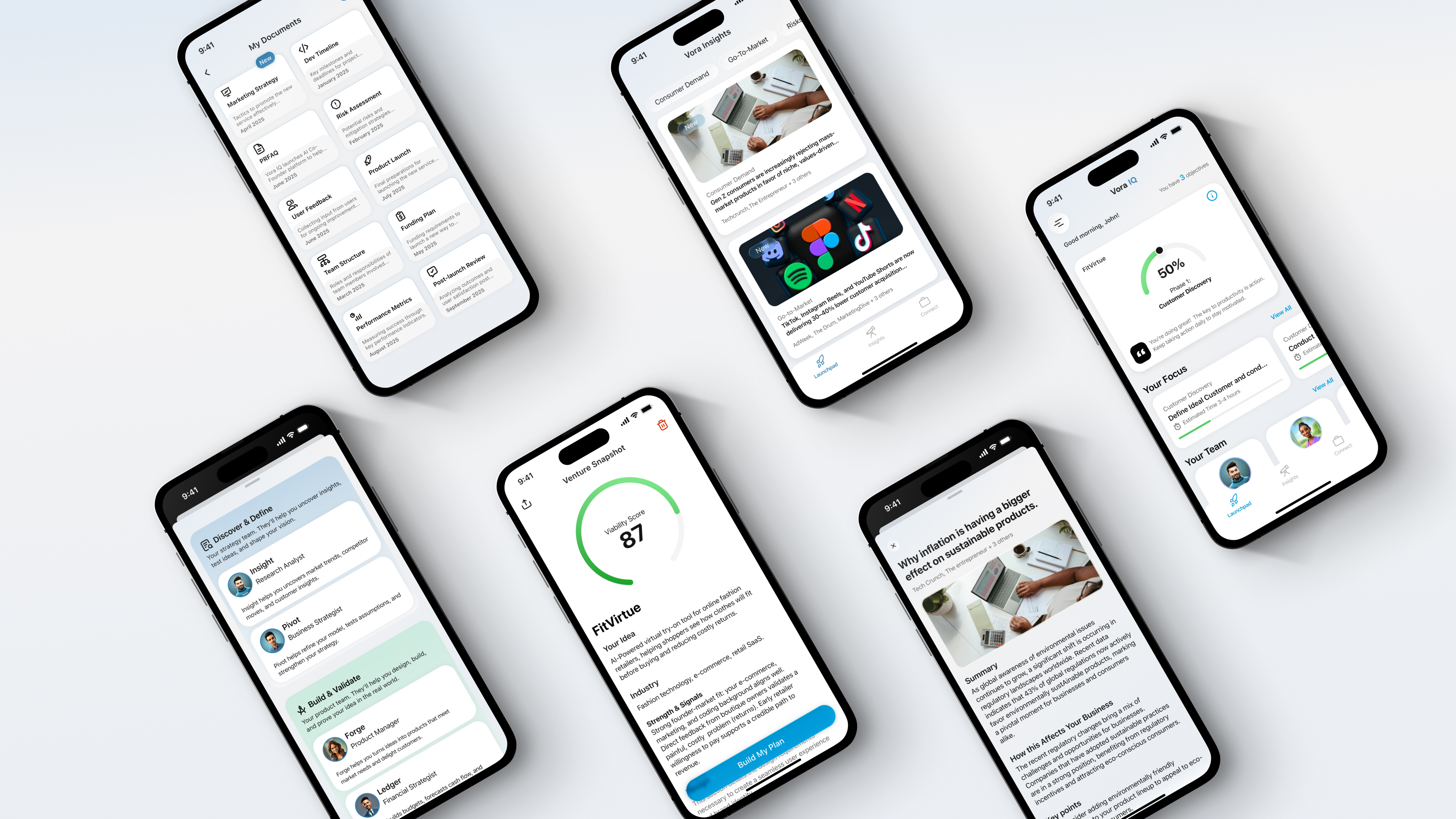
Ideas are evaluated on a clear 0–100 scale with transparent reasoning. Low scores do not block users but explain risks and gaps.
Phased Roadmaps
Execution is broken into clear phases. Users only see what matters now, reducing overwhelm and increasing follow-through.
AI Teammates
Specialized AI agents handle research, marketing, planning, and insights, acting like a lightweight team rather than a single chatbot.
Business Memory
The system remembers decisions, context, and outputs so users do not repeat themselves or lose progress.
Disagree and Commit
A recurring temptation was to add more features early. Social elements, advanced automation, and heavy customization were all proposed. Each time, the decision was to cut back and focus on the core loop: clarity → plan → execution. This restraint protected the product from becoming another bloated founder tool and kept the experience fast, opinionated, and usable.
Outcome
Vora IQ evolved into a cohesive platform that replaces multiple founder tools with a single, intelligent system. Users consistently report faster clarity, reduced overwhelm, and increased follow-through. The product has been accepted into startup programs, presented to angel investors, and positioned as a differentiated execution-first platform in a crowded AI space. Most importantly, users move. They stop planning endlessly and start building.
What This Demonstrates
Designing AI-first products grounded in real user behavior. Creating structure in ambiguous problem spaces. Balancing intelligence, usability, and trust. Building execution systems, not just interfaces. Leading product vision from zero to platform.
Why This Matters
The future of founder tools is not more dashboards or smarter chatbots. It is systems that think with you, guide you forward, and remove friction from execution. Vora IQ demonstrates how thoughtful design, clear principles, and disciplined scope can turn AI from a novelty into a genuine operating system for building companies.
UX Artifacts
Experience it live